Temporomandibular joint dysfunction
Temporomandibular joint dysfunction (TMD) is an umbrella term covering dysregulations of muscle and joint function of the jaw joints, which may be structural, functional, biochemical and psychological in nature. Pain in the temporomandibular joint is often not the leading symptom, the temporomandibular dysfunction can also express itself by dizziness, headache, photosensitivity or panic attacks (palpitations).
Incidence
A temporomandibular dysfunction is found in about 8% of the total population, about 3% are symptomatic and in need of treatment. Symptoms are rare in infants, until puberty the incidence rises. Women of childbearing age are affected more often than men, in the older age TMD is relatively rare.
Possible symptoms
- Restricted jaw opening
- Cracking or rubbing of the TMJ when opening or closing the jaw
- Referred pain in the teeth, mouth, face, head, neck, shoulder or back, cervical spine and shoulder problems, limited head rotation, headache
- Suddenly bad fit of the teeth
- Earache
- Tinnitus (ringing of the ears)
- Dizziness
- Arrhythmia
- Chest pain (pain in the chest caused by tension of the back)
- Difficulty swallowing
- Eye / impaired vision
- Migraine
Diagnosis
For the diagnosis of TMD the following procedure is recommended:
- Detailed medical consultation
- Physical examination of jaw opening, jaw muscles and temporomandibular joints
- Instrumental functional analysis
- X-ray image of the jaw (panoramic radiograph) to exclude dental and oral surgical etiologies
- A questionnaire to evaluate psychosocial impairment
Therapy
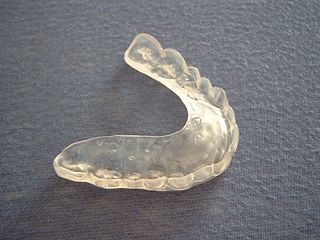
Mouthguard, photo: Metalhead64
A cracking alone does not necessarily require treatment. In case of symptoms self-treatments such as soft food, stretching, heating or cooling applications, relaxation exercises and stress management may be tried. Otherwise medical measures like mouthguards (see figure), pain relieving drugs, electrical nerve stimulation, and in severe cases, dental restorations, orthodontic or surgical measures can be necessary.